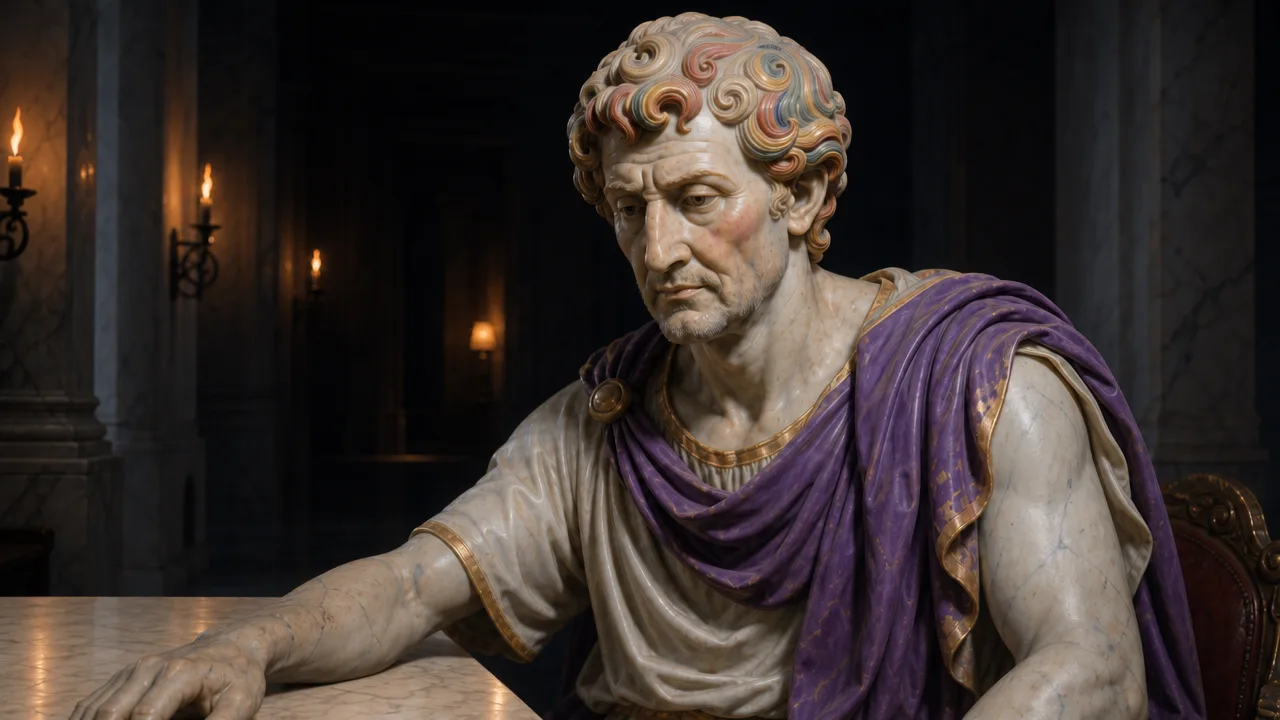


Playing the video loads it from YouTube (Google); data is transferred to Google in the process. Details in the privacy policy.
“Summa Cladis”, Latin for “the sum of the defeat”, is the third part of the Acta Vari series. The film is set in Rome on a night after the news of the Battle of the Teutoburg Forest in AD 9: Emperor Augustus has his accountant reckon up what the defeat has cost the empire.
A night in the palace
The film opens with the call of Augustus: “Quintili Vare, legiones redde!”, “Varus, give me back my legions!” Suetonius reports that after the defeat the emperor kept calling for his legions. The narrator then explains, over a night view of the Palatine, that the conversation that follows is invented. Then Gaius Iulius Eutychus enters, his accountant, with the wax tablets on which he has gathered what this autumn has cost.
Eutychus reads out six items. The first is the commander: Varus marched with three legions through a country he believed to be pacified. The second is the men, three legions, three cavalry units and six cohorts, and the eagles, for which there is no line on the tablet. The third is the war in Pannonia, whose cost determines how much money is left in the treasury. The fourth is the discharge bonus due to every legionary after twenty years of service from the military treasury, a fund Augustus founded with his own wealth. At this item the emperor breaks out. The fifth is the replacement of the lost legions, and the sixth the army on the Rhine, which after the defeat needs more soldiers than stand there.
Eutychus lets the emperor lament and carefully returns to the next figure. Augustus speaks of guilt and betrayal, of Arminius, whom Rome had taken in, of the dismissed Germanic bodyguard and of the question whom he can still trust. In the end Eutychus declares that the sum of the cost of these wars and of this defeat cannot be calculated. Then a servant announces the commander Tiberius, and Augustus has him admitted. Tiberius says a single word: “Caesar.” The film ends on the title card of the next episode, “Caput Vari”.
Recorded, sharpened, invented
As in episode I, the channel asks who pays the bill in the end. We found no documented total in our research, so the film goes through the individual items. The figures come, as far as possible, from the ancient authors. The conversation itself is invented. As in episode I, the characters are painted marble statues, because ancient statues were colourful. Which passages are recorded, sharpened or invented is set out in the notes below.
What is recorded and what we made of it
“Summa Cladis” is a scene, not a transcript. We take dramatic licence as long as we do not distort facts, and we explain here where that licence lies. The notes separate three things: what the ancient authors report, what we have sharpened, and what we have invented.
What is recorded
According to Suetonius, after the defeat Augustus kept calling out: “Quintili Vare, legiones redde!”[1] Three legions, three cavalry units and six cohorts were lost.[2] No ancient source gives the total number of men.[3] That Varus had made money in Syria[4] and that Arminius was a Roman citizen and knight[5] is stated by Velleius.
The items Eutychus reads out in the film have recorded foundations. Pay was ten asses a day.[6] Whoever had served twenty years received a discharge bonus of 12,000 sesterces.[7] It was paid from the military treasury, founded in AD 6 with 170 million sesterces from the wealth of Augustus.[8] To this came five per cent on inheritances and bequests; even then the funds were not enough.[9] A levy of one per cent on sales also flowed into the treasury.[10] The Pannonian war lasted three years,[11] cost many losses and much money.[12]
After the defeat Augustus feared an invasion of Italy. When nobody of military age came forward, Augustus had lots drawn among those who refused, one in five of those under thirty-five and one in ten of the older men. Whoever was chosen lost property and citizenship; when many still did not come, he had some executed. Veterans and freedmen were called up; the Germanic bodyguard was dismissed and taken to islands.[13][14] On the Rhine Asprenas still stood with two legions.[15] He wrote the survey of the empire in his own hand.[16]
What we sharpened or invented
The narrator says at the outset that the conversation with the accountant is invented. Also invented are its wording, the accountant Gaius Iulius Eutychus, who is imagined as a Greek freedman, and the servant. Also invented is that Eutychus lays the books before Augustus that night. A chief accountant of Augustus is not known by name. Also invented are the nocturnal visit of Tiberius, gestures and expressions, and the outburst in which Augustus strikes the counting board and shouts.
The thoughts of guilt and betrayal attributed to Augustus are interpretation. No source gives a reason for the choice of Varus, and that Augustus already knew Arminius as a leader is not attested. “Baceolus”, a simpleton, is a word from letters of Augustus.[17] It is not attested for Varus; in the film Augustus ends by calling the one who sent Varus the idiot, that is, himself. The dismissal of the bodyguard is recorded, a betrayal by the bodyguard is not; “But I have always trusted my bodyguard” is narrative. The state of the treasury, too, is only hinted at; we know of no figure.
The 4.5 million sesterces per legion and year are our own assessment. They rest on our own calculation and cover pay only. That Augustus never wants to see the numbers XVII, XVIII and XIX borne again is his will within the drama; no order is recorded.[18]
In a few places the film departs from the sources or abbreviates. Whether all three eagles were lost in AD 9, the sources do not state explicitly. That Augustus speaks of six or eight Rhine legions is his plan; eight legions are attested only for AD 14.[19]
Images and their limits
All images and movements are AI-generated. The statues are not archaeological finds; the forest and eagle images are illustration.
The night view of the Palatine at the start of the film is also freely designed. The columned façades recall the imperial palace that Domitian had built at the end of the first century rather than the dwelling of Augustus, which according to Suetonius was comparatively modest: he lived in the plain house of Hortensius, with short colonnades of Alban stone and rooms without marble.[20] The ruins on the slope did not yet exist in AD 9. Position, hill and vegetation, by contrast, match the Palatine.
Sound and image credits
Images, characters, motion and character voices are AI-generated: animated, painted marble statues, AI lip-sync and voices of Augustus, Eutychus and the servant made with ElevenLabs. The outcry of Augustus and the “Caesar.” of Tiberius are synthetic voices as well. The narration is spoken by Daniel Papcke himself; it is a real recording. The face of Tiberius follows an ancient bust in the J. Paul Getty Museum.[21]
Sounds: the room tone is a recording of a reverberant church interior;[22] beneath it lie the crackle of torches,[23] wind[24] and a filtered evening outside the city.[25] Added are footsteps on stone,[26] writing with the stylus,[27] the clatter at the counting board,[28] the heavy door[29] and the falling chair.[30][31] All recordings come from Freesound and are licensed CC0 1.0; author and number are given in the footnotes.
Sources
The passages were read in online editions (LacusCurtius with the Loeb translation, Latin Library, Livius.org), partly only as excerpts.
- Augustus, Res Gestae divi Augusti, ch. 17.
- Cassius Dio, Roman History, books 55.23 and 55.25; 56.16 and 56.23. Book 56 in English at LacusCurtius
- Suetonius, Divus Augustus 23, 49, 72–73 and 87; Tiberius 16.
- Tacitus, Annals 1.3; 1.11; 1.17; 1.60; 1.78. Book 1 in Latin at the Latin Library
- Velleius Paterculus, Historia Romana 2.117–120. English at LacusCurtius
Footnotes
- ↑ Suetonius, Divus Augustus 23.1–2. Suetonius reports this as hearsay (“ferunt”).
- ↑ Velleius Paterculus, Historia Romana 2.117.1.
- ↑ No ancient source gives the total number of men.
- ↑ Velleius Paterculus 2.117.2–4. Velleius is not well disposed towards Varus.
- ↑ Velleius Paterculus 2.118.2.
- ↑ Tacitus, Annals 1.17. The 900 sesterces a year are our own conversion.
- ↑ Cassius Dio 55.23.1.
- ↑ Augustus, Res Gestae divi Augusti 17. The Res Gestae are self-presentation; they do not mention Varus.
- ↑ Cassius Dio 55.25.4–5.
- ↑ Tacitus, Annals 1.78.
- ↑ Suetonius, Tiberius 16.
- ↑ Cassius Dio 56.16.4 (end of the Pannonian-Dalmatian war).
- ↑ Cassius Dio 56.23.1–4; Suetonius, Augustus 49.1.
- ↑ Suetonius, Divus Augustus 49.1.
- ↑ Velleius Paterculus 2.120.1 and 2.120.3.
- ↑ Tacitus, Annals 1.11 (“quae cuncta sua manu perscripserat Augustus”).
- ↑ Suetonius, Divus Augustus 87.
- ↑ Tacitus, Annals 1.60 (eagle of the Nineteenth Legion). The numbers XVII to XIX are inferred from inscriptions and Tacitus. That they were not reissued later is shown by later lists of legions; no source records an order to that effect.
- ↑ Tacitus, Annals 1.3.
- ↑ Suetonius, Divus Augustus 72 (“aedibus modicis Hortensianis”, short colonnades of Alban stone, rooms without marble) and 73 (plain furnishings).
- ↑ J. Paul Getty Museum, Los Angeles, accession number 71.AA.275 (“Lansdowne Tiberius”), Open Content (CC0).
- ↑ felix.blume, “Church in Chile, inside atmosphere in a reverberant place (Viña del Mar, Las Carmelitas)”, Freesound 395800, CC0 1.0.
- ↑ LordStirling, “torch ambience loop”, Freesound 483692, CC0 1.0.
- ↑ florianreichelt, “Strong Wind”, Freesound 459981, CC0 1.0.
- ↑ felix.blume, “Countryside ambiance at the evening with bird and crow singing far away …”, Freesound 665136, CC0 1.0.
- ↑ SecureSubset, “Footsteps - Stone, Rock, Concrete, Cement”, Freesound 813622, CC0 1.0.
- ↑ Anthousai, “writing - pencil - wide 03.wav”, Freesound 337091, CC0 1.0.
- ↑ Magnesus, “dice9.flac”, Freesound 353843, CC0 1.0.
- ↑ uniuniversal, “Heavy_Wooden_Doors_BE”, Freesound 633281, CC0 1.0.
- ↑ issalcake, “Single Chair hits floor, bounce”, Freesound 115923, CC0 1.0.
- ↑ Soundscape_Leuphana, “chair falling on the ground”, Freesound 210443, CC0 1.0.
On the channel
The next episode, Acta Vari IV, is titled “Caput Vari”. At the end of this episode Augustus has Tiberius admitted.
- Watch the video
- Acta Vari I: Monitio Segestis
- Acta Vari · Mundus Patet: Agmen Mortuorum
- Back to the IMPERIVM ET ARGENTVM home page
- Next episode: Acta Vari IV · Caput Vari COMING