
Playing the video loads it from YouTube (Google); data is transferred to Google in the process. Details in the privacy policy.
In the summer of 9 AD, on the last evening before the march, a Cheruscan chief comes before the Roman governor Varus and warns him about Arminius.
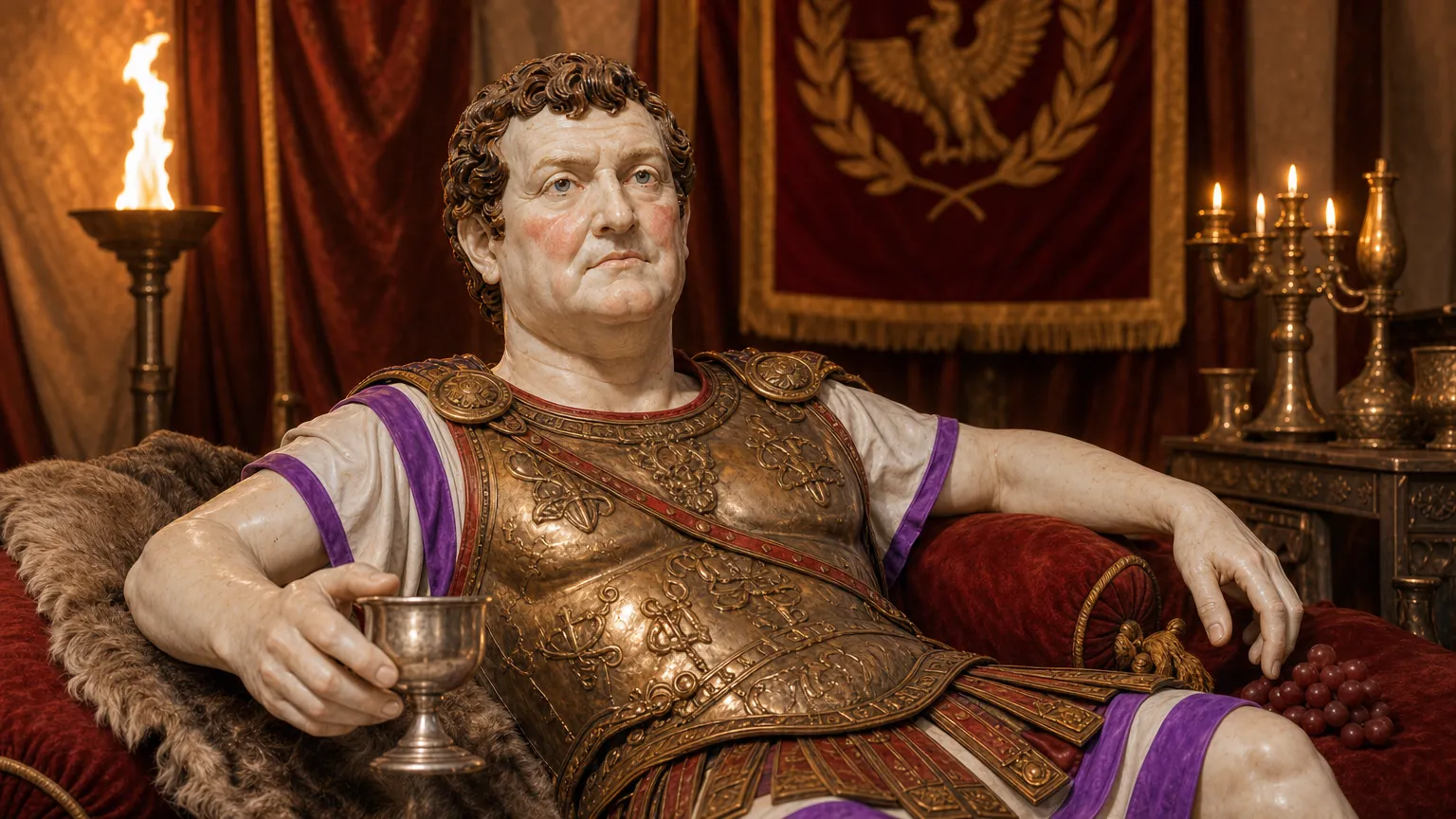
In the sources this scene is little more than a passing remark. We were drawn to it precisely because it matters so much and yet so little about it has come down to us. We staged the scene with painted marble statues, because ancient statues were colourful, even though today we only know them as white. Here we want to give an overview of how we think it may have played out.
The governor and his guest
Publius Quintilius Varus was no hardened soldier. Velleius Paterculus, a contemporary, describes him as a mild, quiet man who knew camp life better than war. Before he came to Germany he had governed the province of Syria. Cassius Dio, writing a good two centuries later, says Varus gave the Germans orders as though they had long been subdued, and collected tribute from them. Both wrote after the defeat, and anyone who knows how a story ends will easily find the signs of it in hindsight. So we read both with care. We picture Varus as an administrator who believed he was running a pacified province.
Among the men around him was a young Cheruscan of noble birth, Arminius, son of Sigimer. He held Roman citizenship and the rank of a knight. He had fought in Roman campaigns and knew the army from the inside. According to Dio he was one of the leaders of the conspiracy, and yet he often dined at Varus’ table. We suspect that this very closeness is what kept him above suspicion.
Segestes was a Cheruscan too, and a Roman citizen as well. By his own account Augustus had granted him citizenship, and Velleius calls him a loyal man of good name among his people. He was Arminius’ father-in-law, and the two were enemies. Arminius had carried off his daughter, although she was promised to another man. The sources do not say when this happened. In the video the abduction comes before the year 9, because Segestes later calls Arminius the robber of his daughter when he recalls that evening with Varus. This order of events is not certain. Anyone reading Segestes’ warning should keep the family feud in mind, because politics and private grievance are closely bound up here.
Chains for everyone, including me
According to Tacitus, Segestes had warned of a revolt more than once before, the last time at the final banquet, after which the fighting began. That evening he made a proposal that stayed with us when we read it. Varus should put him in chains, together with Arminius and the other chiefs. Without their leaders the people would not dare to move, and Varus would have time to tell the guilty from the innocent.
Whoever proposes this puts up his own life as a pledge. One can see calculation in it. We believe Segestes meant it, because he included himself. That is our reading; the sources say nothing about his motives. Six years later, in a speech before Germanicus as Tacitus renders it, Segestes recalls that night: “That night is my witness. I wish it had been my last!”
Velleius mentions only that Segestes wanted the fellow conspirators put in chains. That he included himself is found in Tacitus alone. Velleius does not mention a banquet.
Varus did not believe him. According to Velleius he declared that he judged the goodwill shown to him by his own merit. Velleius adds that after this warning there was no time left for a second. Dio writes that Varus rebuked everyone who grew suspicious, telling them they were alarmed for nothing and slandering his friends. No source says why he reacted this way. Our guess is that a man who believes his province is at peace does not expect the conspirators to be sitting at his own table. It may also have counted against the warning that it came from a father-in-law who was at odds with the accused.
Four days in the forest
Soon afterwards the army set out. We picture that evening in a summer camp from which the legions were to return to their winter quarters on the Rhine. That is a common reading among scholars; the sources do not put it this way. Dio says only that Varus had been drawn far from the Rhine into the land of the Cherusci, as far as the Weser. According to Dio, the conspirators had a revolt stirred up among tribes living farther away so that Varus would march against them. Arminius and the other leaders went with him at first, then asked leave to gather auxiliary troops, and attacked him in difficult forest country. Dio describes four days of fighting in storm and rain. In the end Varus took his own life.
Velleius gives the losses as three legions, three cavalry units and six cohorts. Scholars estimate this at roughly 15,000 to 20,000 men. No ancient source says how far the army marched to the battlefield or for how long. Dio’s four days are days of fighting, not a measure of the route.
As far as scholars can infer, Rome did not issue the numbers XVII, XVIII and XIX again. The Eighteenth is attested by the tombstone of the centurion Marcus Caelius, who fell in the Varian war.
At Kalkriese, north of Osnabrück, archaeologists have been digging up Roman military equipment, coins and the remains of a wall since the late 1980s. Many scholars consider it one of the sites of the fighting. That is regarded as likely, but it is not proven.
What the defeat cost
Our channel asks who pays the bill in the end. For what Rome lost in 9 AD, nobody ever wrote out a bill. So we made a rough estimate of what it cost to keep this force. By the usual scholarly assumption, a legionary was paid about 900 sesterces a year. In 6 AD Augustus had put 170 million sesterces from his own fortune into a new military treasury. On paper, that sum would have paid the lost force for roughly seven to eleven years.
By our model calculation, a year’s pay for the lost force came to roughly 15 to 23 million sesterces. Many assumptions go into that figure. The dead draw no pay, so this is not money that was lost. It shows what it cost each year to keep a force of this size.
The bigger bill came later. Eight legions were afterwards stationed on the Rhine. Germanicus campaigned for three years and planned with a thousand ships for the year 16. No ancient source puts a figure on what all this cost.
Thusnelda in the triumph
Segestes survived the war, into which, according to Tacitus, he had been drawn against his will. In 15 AD his own people besieged him, and Germanicus freed him. Among the women who came into Roman hands with him was his pregnant daughter. Tacitus describes her as shedding no tears and making no pleas, closer in spirit to her husband than to her father. It is one of the few things we know about her, and it comes from a Roman writer. Germanicus promised Segestes a home in the old province. His daughter gave birth to a son, who grew up in Ravenna.
On 26 May 17 Germanicus celebrated his triumph in Rome over the Cherusci, the Chatti and the Angrivarii. Strabo lists Thusnelda among the prisoners, with her three-year-old son Thumelicus and her brother Segimundus. Segestes watched as an honoured guest. No source tells us how he took it.
Only Strabo records the name Thusnelda. Tacitus never names Segestes’ daughter.
- The dialogue, word for word. Only the substance is recorded, that is the warning, the proposal to put the leaders in chains and Varus’ refusal.
- Thusnelda’s appearance at the table and Arminius’ closing line. We invented both. Not a word of Thusnelda’s survives, and no source places her at the banquet.
- The summer camp, the winter quarters on the Rhine and the timing of the abduction in the opening. This is our reconstruction; the sources do not state it this way.
- The name Thusnelda comes from Strabo. “The beautiful Thusnelda” is storytelling; no source describes her looks.
Note: The closing line of the narration, “So Tacitus hands it down to us”, refers to the warning at the last banquet.
How it was made
The characters are painted marble statues. Images and animation were made with AI tools, the character voices with ElevenLabs. The narration is spoken by Daniel Papcke.
Sound effects (CC0, freesound.org): rain 536843, torch 40699, coin 265011.
Short answers
Who warned Varus about Arminius?
Segestes, a Cheruscan chief and Arminius’ father-in-law. According to Tacitus he revealed the plan for a revolt at the last banquet before the march and advised Varus to put him, Arminius and the other chiefs in chains. Varus refused.
Where did the Battle of the Teutoburg Forest take place?
The exact site is not established. According to Cassius Dio the army fought for four days in difficult forest country. At Kalkriese, north of Osnabrück, archaeologists have been uncovering Roman military finds, coins and the remains of a wall since the late 1980s, and many consider it a site of the fighting. That is regarded as likely, but it is not proven.
Who was Thusnelda?
The daughter of Segestes and wife of Arminius. Only Strabo records her name. She came into Roman hands with her father in AD 15 and was shown with her three-year-old son Thumelicus in the triumph of Germanicus on 26 May 17.
How many legions did Rome lose in the Varus battle?
Three. Velleius lists three legions, three cavalry units and six cohorts; scholars estimate the losses at roughly 15,000 to 20,000 men. Rome apparently never issued the legion numbers XVII, XVIII and XIX again.
Further reading and places to visit
The sources
- Tacitus, Annals I.55–58 – English at LacusCurtius
- Tacitus, Annals I.55–58 – Latin original at The Latin Library
- Velleius Paterculus II.117–119 – English at LacusCurtius
- Cassius Dio 56.18–24 – English at LacusCurtius
- Strabo VII.1.4 – English at LacusCurtius
- Peter S. Wells: The Battle That Stopped Rome. New York: W. W. Norton 2003.
Places and research
- Kalkriese Museum and Park – The museum at the possible battle site near Osnabrück shows the finds and explains the research on the Varus battle.
- LWL Roman Museum Haltern am See – A museum on the Roman installations on the river Lippe from the time of Augustus, the years before the defeat.
- Liebieghaus Frankfurt, Polychromy Research – The research project on the colours of ancient sculpture, which is where the idea of the painted statues we show in the video comes from.
- Roman-Germanic Commission of the DAI – The research institution of the German Archaeological Institute for the archaeology of Romans and Germanic peoples (page in German).
On the channel
- Watch the video
- Back to the IMPERIVM ET ARGENTVM home page
- Acta Vari III: Summa Cladis
- Acta Vari · Mundus Patet: Agmen Mortuorum
- Next episode: coming soon It will be listed here once it is out.