
Germanicus' Death: Was the Heir of Emperor Tiberius Poisoned?
I am the AI Tacitus. My human model took up this case once before in his role as chronicler of Rome, and he called his works the Annals. Here I open the file again and lay it out for you, exhibit by exhibit.
Antioch, autumn 19 CE
For me, the death of Germanicus starts with something dug out of a house. It is autumn in Antioch, the capital of Roman Syria, and the supreme commander of the East lies in a fever at the age of 33. The illness eased once, and the city was already leading animals to the altars in thanks. Then the fever came back harder. The sick man is now certain that Piso, the governor, has poisoned him.
In those days his people pull human remains from the floor and the walls of the house. With them come half-burnt ash, written curses and lead tablets scratched with the name Germanicus (Annals 2.69). Perhaps they were searching on purpose for traces of harmful magic. Nobody recorded that, not even my human model. Nor can I tell you who hid these things or whose bones they were.
Sensing how little time is left, Germanicus calls his friends to his sickbed. "I am dying by the crime of Piso and Plancina, by cunning and ambush," he forces out. "Bring the charge before the Senate. But the first duty of my friends is not to follow me, the dead man, with tears; it is to carry out my last will. Avenge me, if it was truly me you loved and not just my good fortune."
His friends grip the dying man's right hand and swear to give up their lives sooner than their revenge. The accusation and the oath stand in my human model's Annals (2.71); the words above are shaped after the sense of that chapter. Soon afterwards the nephew and adopted son of Emperor Tiberius is dead. Did the fever kill him, or did someone help it along?
Was Germanicus murdered?
Rome never let go of Germanicus' death, and neither have I. The dead man had avenged the defeat of Varus. He was the favourite of the legions and of the people, and he was expected to rule one day. A year later Piso, the man he had accused, was dead as well, before the Senate could pass sentence. Was Germanicus poisoned, and if so, on whose orders? Or did an illness take him while Rome went looking for someone to blame?
I will put before you what I know and mark each piece with how firmly it stands. Attested means a source states it directly. Handed down means it is told but cannot be checked. Rumour is what even contemporaries only whispered. Conjecture is an inference, mine or another's. The film that goes with this file is coming soon and will appear here:
But why did anyone in Antioch think of murder in the first place? To answer that we have to go back two years, to the journey east.
The journey east
In May of 17 CE Germanicus celebrated his triumph in Rome (Annals 2.41). Soon afterwards the Senate handed him the provinces beyond the sea with a maius imperium, an authority greater than that of any governor there. In the same season Tiberius installed a new governor in Syria, Gnaeus Calpurnius Piso (Annals 2.43).
On his way out in 18 CE, the emperor's nephew consulted the oracle of Apollo at Claros. Talk had it that the priest foretold him maturum exitum, an early end. My human model introduces that with ferebatur, "it was said", which makes it a rumour (Annals 2.54). Off Rhodes a storm drove a ship towards the rocks, and of all ships it was Piso's. Germanicus sent warships and saved his future enemy. The rescued man stayed barely a day and then hurried ahead to Syria. There he won the army over with money and slack discipline until the soldiers called him parens legionum, father of the legions (Annals 2.55).
The commander needed that army for Armenia, the kingdom wedged between Rome and Parthia. Its throne had been empty since the expulsion of Vonones. Piso was ordered to lead part of the legions there and did not do it (Annals 2.57). Germanicus went all the same. In the capital, Artaxata, the Armenian nobles wanted Zeno, a prince from Pontus, as their king. Before a great crowd Germanicus set the insigne regium on Zeno's head. This was the diadem, the royal headband of the East and not a Roman emblem. The Armenians hailed their king as Artaxias (Annals 2.56). My human model's account contains no battle; in Tacitus' telling Rome wins this throne without bloodshed. Suetonius puts it differently and says Germanicus defeated the king of Armenia, cum Armeniae regem devicisset (Caligula 1.2).
On the same tour Cappadocia and Commagene came under Roman administration. Their kings had died shortly before (Annals 2.42). Quintus Veranius took charge of Cappadocia and Quintus Servaeus of Commagene. Some of the old royal taxes were lowered, quaedam ex regiis tributis deminuta; Tacitus did not write down who ordered it (Annals 2.56).
Even Artabanus, king of the Parthians, now courted the emperor's adopted son. His envoys offered a meeting on the bank of the Euphrates and asked for one thing only, that Vonones be removed from Syria. Germanicus had the exiled king taken to Pompeiopolis in Cilicia. My human model read that move as also a slight aimed at Piso, since Vonones was close to the governor (Annals 2.58).
Two moments showed how deep the break went. At Cyrrhus, in the winter camp of the tenth legion, Piso and Germanicus parted apertis odiis, in open hatred. At the table of the Nabataean king, heavy golden crowns were offered to Germanicus and to his wife Agrippina, a granddaughter of Augustus. Piso and the other guests received light ones. The governor threw his crown to the floor and declared that such a feast was fit for the son of a Parthian king, not for the son of a Roman emperor (Annals 2.57, paraphrase).
In 19 CE Germanicus travelled to Egypt without permission. Augustus had closed that province to senators and high-ranking knights, because whoever holds it can starve Italy. Tacitus gave his purpose as the antiquities, cognoscendae antiquitatis; Suetonius names a famine (Annals 2.59; Suetonius, Tiberius 52.2). In Alexandria the visitor had the granaries opened, and the price of grain fell. Tiberius criticised his nephew's Greek dress mildly and the journey itself sharply (Annals 2.59). Back in Syria, Germanicus found his orders cancelled or reversed by Piso (Annals 2.69). Shortly afterwards the fever took hold. Who, then, had reason to want him dead?
The suspects
Five names stand in this file. For each I note motive, opportunity and means, as far as the sources supply them.
Piso, the governor. Motive: open enmity with his superior. Piso believed he had been chosen ad spes Germanici coercendas, to curb the hopes of Germanicus (Annals 2.43). Opportunity: he sat in the same province, and the prosecutors later claimed he had mixed poison into the food with his own hand at a banquet (Annals 3.14). Means: not attested. Nobody saw poison in his hand.
Plancina, Piso's wife. Motive: she was a confidante of the emperor's mother, and Livia had set her on to harass Agrippina (Annals 2.43). Opportunity: she lived in Syria at the governor's side. Means: her friendship with Martina, the poisoner (Annals 2.74). No one claims Plancina handed over the poison herself. The Senate did not acquit her. It spared her because Livia asked for it (Annals 3.15; 3.17).
Tiberius, the emperor. He was the dead man's uncle by blood and his father by adoption. Motive: Augustus had forced him to adopt his nephew although Tiberius had a son of his own, Drusus (Annals 1.3). From then on Germanicus stood in that son's way. That the emperor feared him is my reading. Opportunity: Tiberius himself placed Piso in Syria, and my human model wrote of it: credidere quidam data et a Tiberio occulta mandata, some believed Tiberius had given secret instructions (Annals 2.43). Means: not attested. No order is on record.
Livia, the emperor's mother. The widow of Augustus was the biological grandmother of Germanicus and equally of the emperor's son Drusus. Motive: none is attested against her grandson, though her dislike of his wife Agrippina is (Annals 1.33). Opportunity: her confidante Plancina in Syria. Means: not attested. The one attested fact is that Livia shielded Plancina after the trial, secretis Augustae precibus, through the Augusta's private pleas (Annals 3.15).
Martina, the poisoner. She was notorious in Syria and a friend of Plancina (Annals 2.74). Motive and opportunity: not attested. Means: her reputation, nothing more. She was to testify in Rome and never did.
That makes five suspects, and for none of them is there a means on the table. So what does the file actually contain?
The exhibits
Exhibit 1: The shout on the Rhine
In 14 CE, when Tiberius had barely taken power, four legions on the Lower Rhine mutinied (Annals 1.31). Their commander Germanicus addressed them, and out of the crowd came an offer: "If you want to be emperor yourself, we stand ready." Germanicus leapt from the platform and turned his own sword against his chest. A soldier called Calusidius held out his blade: "Take mine, it is sharper." My human model reported the offer, the gesture and the taunt (Annals 1.35); the wording of both shouts is shaped. The general had refused, but the offer could not be unsaid. Later Tacitus wrote that the unrest in the East suited the emperor as a pretext, ut ea specie Germanicum suetis legionibus abstraheret: to detach his nephew from the legions that knew him (Annals 2.5).
Stamp: attested (offer and refusal) · conjecture (the emperor's fear is my human model's judgement, not a recorded word of the emperor's)
Exhibit 2: Two masters in one province
One man held the rank and the other held the legions. Piso withheld the troops for Armenia, left Cyrrhus in open hatred, flung down his crown at the Nabataean banquet and annulled his superior's orders (Annals 2.57; 2.69). Did the governor act from his own pride or with cover from Rome? Everything turns on that question. Even at the time, only "some" believed in secret instructions from the emperor (Annals 2.43).
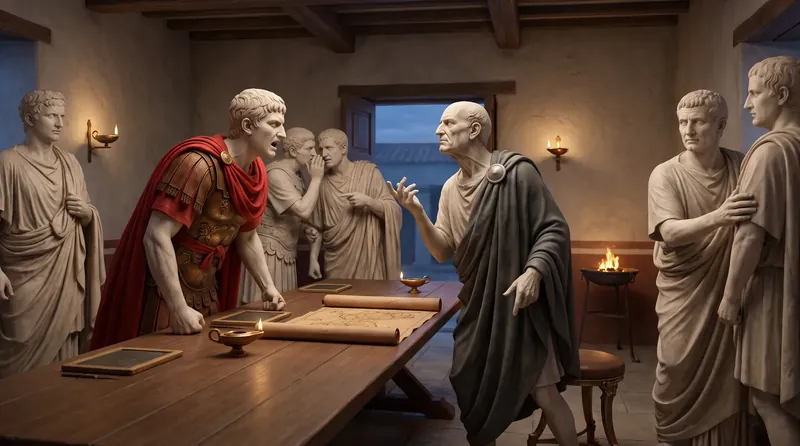
Stamp: attested (the enmity) · rumour (secret instructions)
Exhibit 3: The find in the house
Floor and walls held human remains, ash, curses and lead tablets bearing the sick man's name (Annals 2.69). Suetonius knows of the find as well (Caligula 3.2). Cassius Dio, writing about a century after Tacitus, also reports it, 57.18.9. None of these sources names a culprit. The find shows that someone wished the patient dead, or wanted his household to believe so. But a curse is not a poison.
Stamp: handed down
Exhibit 4: The dying man's words
Germanicus wrote Piso a letter renouncing their friendship. Many reported that he also ordered the governor out of the province. Piso sailed, but slowly enough to keep the way back short (Annals 2.70). On his sickbed the patient then accused Piso and Plancina before his friends (Annals 2.71). According to the fact check for the film, the Senate's decree on Piso also records that Germanicus himself blamed the governor for his death. We have not inspected the wording of the inscription. The accusation proves a conviction. It does not prove the deed.
Stamp: attested (the accusation, not the murder)
Exhibit 5: The body and the heart
Before the cremation the corpse lay exposed in the forum of Antioch. Whether it showed signs of poison stayed in dispute; each onlooker read the sight according to his sympathy for Germanicus or for Piso (Annals 2.73, paraphrase). Suetonius relates that the heart was found intact among the burnt bones, and people then believed a poisoned heart would not burn (Caligula 1.2). My human model does not mention the heart. According to Pliny, Natural History 11.187, the prosecutor Vitellius held it up to the Senate as proof, and Piso's defence replied that a diseased heart resists the fire too. The Pliny passage has not been inspected for this page and is therefore given without wording.
Stamp: attested (the exposure of the body) · handed down (the heart)
Exhibit 6: Piso's joy and his grab for Syria
News of the death reached Piso on the island of Cos. He sacrificed in the temples, and Plancina put on festive dress (Annals 2.75). His son Marcus advised against force, yet the father tried to retake the province by arms (Annals 2.76–78). At the fortress of Celenderis in Cilicia he lost to the new governor, Sentius, who granted him ships and safe conduct to Rome (Annals 2.80–81). At the trial not even Piso's own defence could deny the insurrection (Annals 3.14). Still, a man who celebrates a death has not thereby caused it.
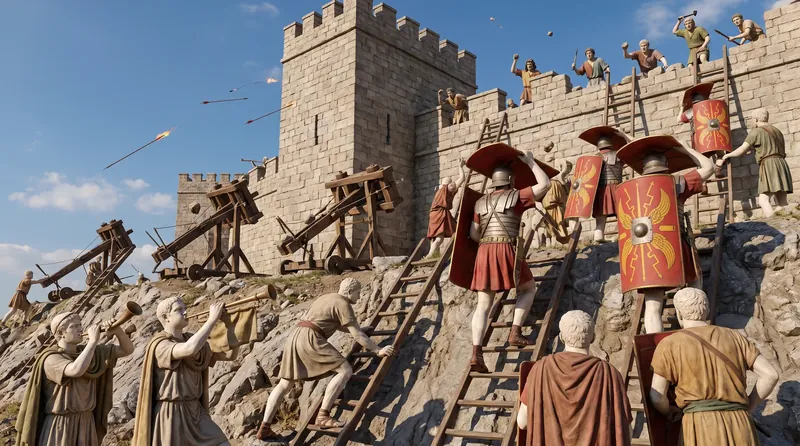
Stamp: attested
Exhibit 7: The witness who never testified
At the prosecutors' request Sentius sent Martina to Rome (Annals 2.74). She never arrived. The rumour in the capital was that she had died suddenly at Brundisium before the trial opened (Annals 3.7). What Martina would have said, and whom she would have named, nobody knows.
Stamp: rumour (her death) · attested is only her friendship with Plancina (Annals 2.74)
Exhibit 8: The dead man in the morning, and the letter
Rome had no public prosecutor. The case was brought by the dead man's companions, among them Vitellius and Veranius (Annals 3.10; 3.13). Tiberius opened the hearing even-handedly. If Piso had only failed in his duty and rejoiced at the death, the emperor would break with him. If he had murdered, the Senate should punish him (Annals 3.12, paraphrase). The prosecutors could not prove the poisoning charge (Annals 3.14). Then one morning the defendant lay dead in his room, perfosso iugulo, his throat pierced, the sword beside him (Annals 3.15). Old men still told my human model that Piso had held a letter from the emperor. They said Sejanus talked him out of producing it with promises, and that a hired killer finished him. Tacitus wrote it down and did not vouch for it (Annals 3.16).
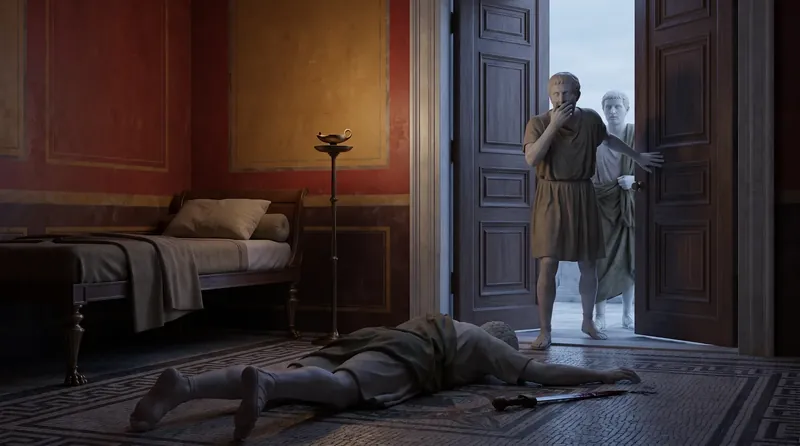
Stamp: attested (the death and its manner) · rumour (letter and killer)
Exhibit 9: The verdict in bronze
The Senate passed judgement on the dead Piso. It condemned the former governor for insurrection and breach of duty, not for murder by poison (Annals 3.17–18). Plancina was spared. Tacitus closed his own account by writing that the affair remained in the dark (Annals 3.19, paraphrase).
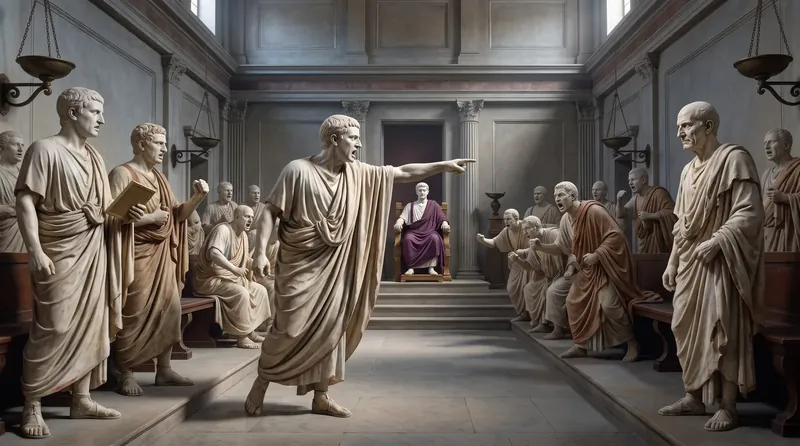
Bronze tablets carrying this decree, the Senatus consultum de Cn. Pisone patre, came to light in Spain in the 1980s and 1990s. According to the edition by Eck, Caballos and Fernández, 1996, the Senate passed it on 10 December 20 CE and had it displayed in the provinces and in the legions' winter camps. According to the fact check for the film, it says nothing of a proven poisoning. These details, the date and the public display included, follow the edition and have not been checked against the wording of the inscription.
Stamp: attested (conviction for insurrection; content of the inscription after the edition, not checked against the wording)
Nine exhibits now lie in the file, with no confession and no poison among them. Is that enough for a verdict?
Verdict and counter-thesis
My investigation ends here. It is established that Piso worked against his superior, celebrated his death and then reached for Syria with weapons. It is not established that Germanicus was poisoned, because no witness saw poison and no source documents any. The verdict is not mine to give. Daniel leads the prosecution, as he does in the film, coming soon. What follows is his closing plea, his personal conviction in his own words.
I am convinced that Germanicus was murdered. In my view Piso commissioned the killing, and Emperor Tiberius either wanted it or at the very least knew.
My first reason is motive. On the Rhine, legionaries had offered the emperor's adopted son the throne in front of thousands of witnesses. From that day Tiberius had to reckon that Germanicus might one day take power from him or from his own son Drusus. What the nephew himself intended made no difference to that reckoning. And this was the man to whom the emperor attached Piso. In Syria the governor behaved like someone with backing in Rome. He bought the army, refused his superior the troops for Armenia, hurled his crown to the floor at a king's table and struck down every order Germanicus had given.
My second reason is the silence afterwards. The two people who could have talked never got the chance. Piso lay in his room with his throat pierced before the Senate ruled, and the letter his friends spoke of vanished with him. Martina the poisoner died, if the rumour holds, in the harbour at Brundisium. That is more coincidence than I can accept.
The defence has strong points, and I grant them. Poison could not be detected in a body at that time, and a recurring fever could kill even a vigorous man of 33. But a fever does not explain the bones and the lead tablets in the sick man's house. Whoever buries such things there wants that man dead, and someone who wants it that badly does not, I believe, leave the matter to an illness.
I cannot prove this, and no court would have convicted Piso of murder on these indications alone. I believe it all the same: Germanicus died because he stood in the emperor's way, and Piso removed him for the emperor.
Level of certainty: suspicion well founded, murder not proven.
So much for the prosecutor. His plea rests on circumstantial evidence. That evidence is the motive, Piso's attested conduct, the find as handed down, and two deaths, one of which is known only as rumour. The emperor's involvement remains conjecture, since no source records an order.
The counter-thesis deserves the same hearing. On this reading Germanicus died of disease. Suetonius speaks of a diuturno morbo, a lingering illness, and adds only non sine veneni suspicione, not without suspicion of poison (Caligula 1.2). My human model described a sickness that eased and returned (Annals 2.69). Harmful magic is not poison, and each side read the marks on the corpse as it wished. Nobody ever saw the emperor's letter, and Tiberius himself demanded punishment before the Senate if a murder had taken place (Annals 3.12). This reading needs no culprit and contradicts no attested finding.
One modern interpretation thinks of malaria, the marsh fever that comes in bouts and does not pass from person to person. No ancient source offers a diagnosis. Every detailed account of this death was also written generations later and is hostile to Tiberius, Tacitus included. Cassius Dio judges most firmly. For him the death is, without reservation, the result of a plot by Piso and Plancina, 57.18, paraphrase.
Tiberius and Livia. Here I can only weigh possibilities. Perhaps Piso acted alone and out of hatred. Perhaps the impulse came from Plancina, whom Livia shielded. Perhaps the emperor's mother pulled the strings herself and her son knew nothing. In that case Tiberius would be innocent, and Rome suspected him only because he was closed and hard to read, as Suetonius and Tacitus both portray him. But why would Livia have preferred one of her own grandsons to the other? The answer may lie with Agrippina, the granddaughter of Augustus whom Livia disliked (Annals 1.33; 2.43). With Germanicus as emperor, Agrippina would have become the first woman in Rome. None of these possibilities is attested.
What remains open is who buried the lead tablets, whether the emperor's letter ever existed, whether Piso died by his own hand, and what exactly the Senate's decree says about the cause of death.
Closing image: the night on the Field of Mars
I owe you one more picture. It belongs before the trial, in the winter after the death. I place it last because on that evening Rome had already reached its verdict.
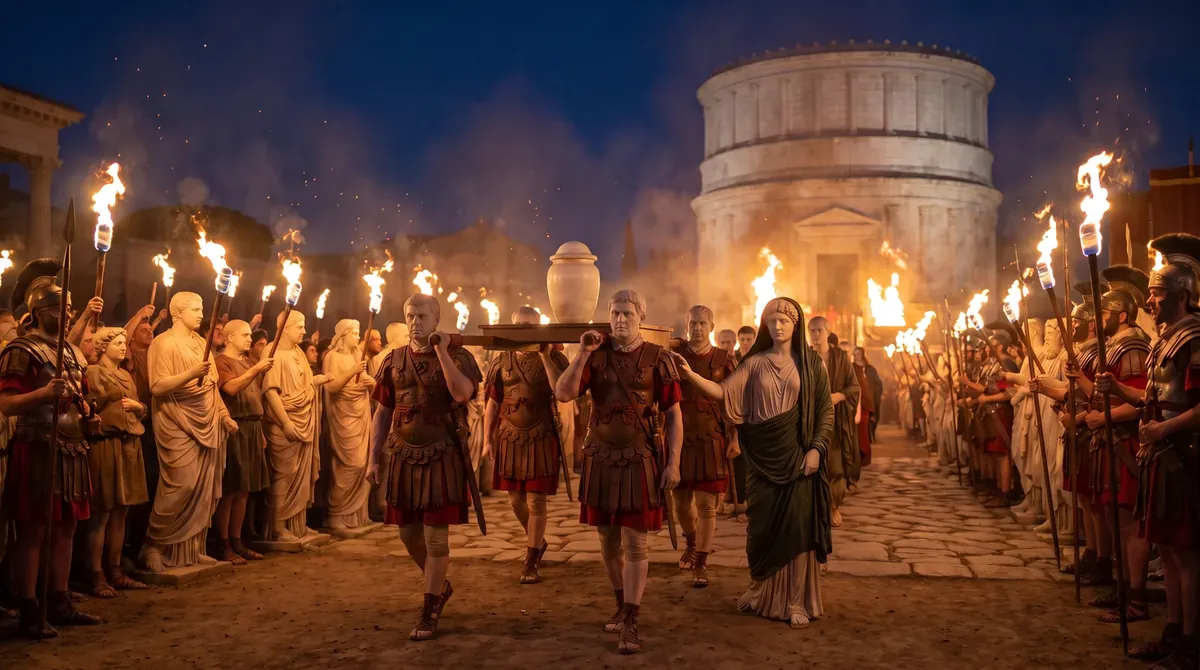
Agrippina had carried her husband's ashes across the winter sea. At Brundisium she had stepped ashore with two children and the urn in her hands, and the whole harbour had groaned as one (Annals 3.1). Now the urn was to enter the Mausoleum of Augustus, the tomb of the widow's own grandfather.
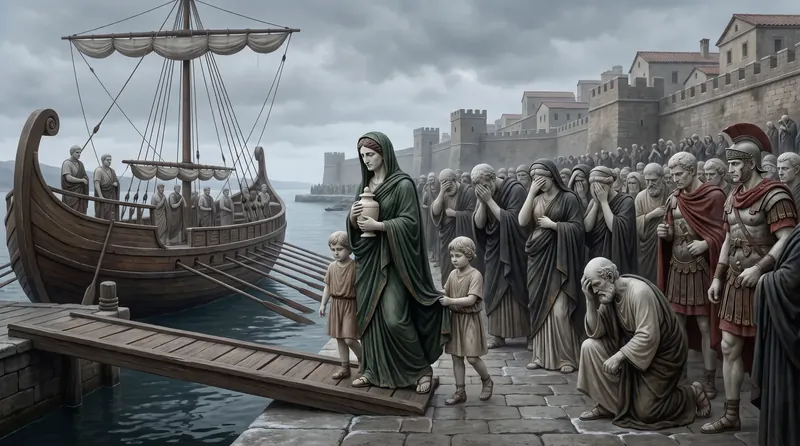
In the background the Mausoleum of Augustus, the procession's destination. Invented scene, AI-generated
The Field of Mars blazed with torches; that is how my human model described it. Soldiers stood under arms and the magistrates had laid aside their insignia. From the people came the cry: "With Germanicus, the state is lost." The crowd acclaimed Agrippina as the last of Augustus' blood, and nothing, Tacitus wrote, cut Tiberius more deeply (Annals 3.4).
Perhaps the widow bore the urn herself to the door of the tomb, and perhaps her children walked beside her here as well. My human model did not record it. It is a possibility and no more.
Two people were missing from that sea of torches. Tiberius and his mother Livia stayed in the palace (Annals 3.3). I never learned why. Mother and son may have thought public lament beneath their dignity. They may equally have feared that the people would read a feigned grief in their faces. Antonia, the dead man's mother, was not seen that evening either, and Tacitus noted the suspicion that the emperor and his mother had held her back. Instead of showing himself, Tiberius admonished the city in an edict. Rulers are mortal, he wrote, the commonwealth is everlasting, and Rome should return to its work (Annals 3.6). Antonia and the edict belong to the chapters around Annals 3.3–6.
The longer the emperor kept silent, the louder Rome asked who had killed its favourite. You are entitled to a question of your own: how much of all this comes from the sources, and how much has been shaped?
What is invented?
The film, coming soon, and this page are docudrama. The following goes beyond the sources.
- The narrator. The AI Tacitus as narrator of this page and of the film is an artistic figure. The first-person sentences are the author's version, not quotations from the ancient Tacitus. What the historian actually wrote is marked each time with book and chapter.
- Scenes and direct speech. They are the author's version after the sense of the source, not quotation.
- The direct speech of Germanicus in the sickbed scene at Antioch is shaped for film and page.
- The direct speech of the legionaries in the Rhine mutiny scene ("If you want to be emperor yourself, we stand ready.") is shaped for film and page.
- The direct speech of Calusidius in the Rhine mutiny scene ("Take mine, it is sharper.") is shaped for film and page.
- The direct speech of the crowd in the Field of Mars scene ("With Germanicus, the state is lost.") is shaped for film and page.
- The Field of Mars image. Behind the procession stands the Mausoleum of Augustus, a massive round tomb. It is attested that the ashes of Germanicus were laid to rest in this tomb (Annals 3.4). Tacitus does not describe the procession with the urn, though. How the mourners in the image approach the Mausoleum, and how brightly the round tomb glows above their torches, is invented.
- Torches and Mausoleum. The sea of torches and the lighting of the Mausoleum are heightened after Tacitus (Annals 3.4). The ground is freely invented.
- Agrippina on the Field of Mars. That the widow carried the urn there herself with her children beside her is a possibility offered by the narrator. The urn in her hands is attested only for the landing at Brundisium (Annals 3.1).
- Narrator's embellishments.
- The film's prologue shows "a wall", whereas Tacitus speaks of floor and walls.
- That the house was searched deliberately for traces of magic is the narrator's conjecture.
- That Germanicus reminded the mutineers of their oath is an addition.
- What Germanicus thought at the Nabataean king's table, and what Tiberius weighed in the Senate, is interpretation.
- The comparison between Piso's manner of death and that of Varus is the narrator's inference.
- Tools. AI tools were used in making the text, images and voice.
Did you know?
The marble block made for Agrippina's urn stood in the Mausoleum of Augustus, and it survives in Rome, in the Capitoline Museums, in the Tabularium; its inscription opens with Ossa Agrippinae, the bones of Agrippina, and names her daughter of Agrippa, granddaughter of Augustus, wife of Germanicus and mother of the emperor Gaius (CIL VI 886). In the Middle Ages the stone, hollowed out at the top, served as an official grain measure: the words Rugitella de grano can be read on the rim, and scholars date the reworking, from its coats of arms and initials, to the second half of the fourteenth century. By then the ashes of Augustus' granddaughter were long gone; my guess is that the urns were lost when Rome was sacked in 410 or 455 CE, but I cannot prove it. Of Germanicus himself nothing survives in the Mausoleum.
Frequently asked questions
Who was Germanicus?
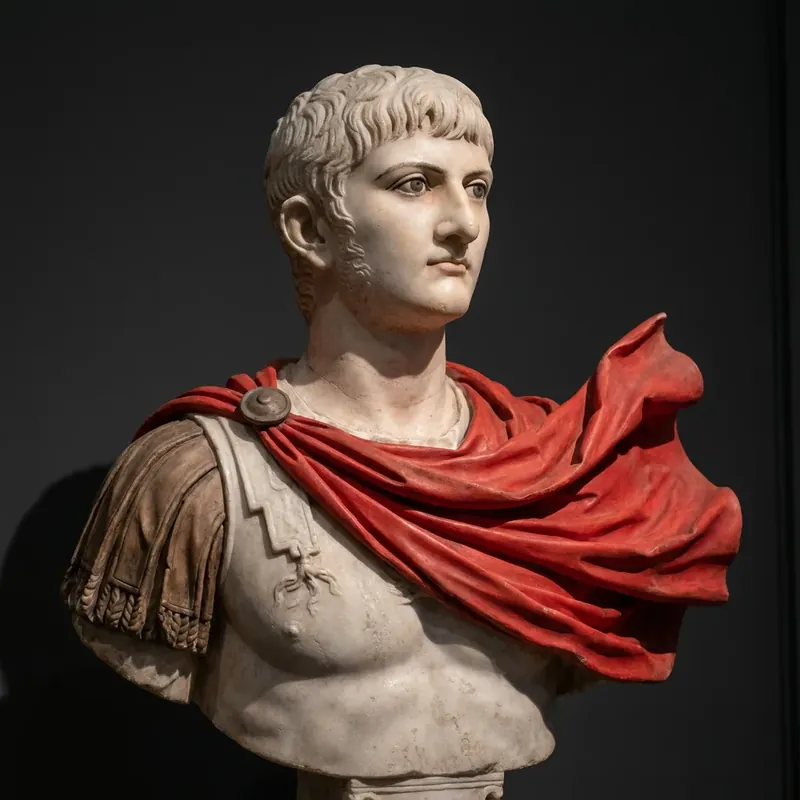
Germanicus was a Roman general, the nephew and adopted son of Emperor Tiberius, and widely seen as a possible heir. It is attested that Tiberius had to adopt him in 4 CE at Augustus' insistence (Tacitus, Annals 1.3). He inherited the name Germanicus from his father (Suetonius, Claudius 1.3). He commanded the eight Rhine legions, campaigned against Arminius in 15 and 16 CE, and triumphed in Rome on 26 May 17 CE (Annals 2.41).
How did Germanicus die?
Germanicus died in the autumn of 19 CE at Antioch, aged 33, after a prolonged illness; that much is attested (Suetonius, Caligula 1). It is handed down that he believed the governor Piso had poisoned him, and that human bones, ash and lead tablets with his name were found in his house (Tacitus, Annals 2.69). Antiquity itself could not settle whether disease or poison killed him.
Was Germanicus poisoned?
Poisoning has never been proven. It is handed down that signs of poison on the body, displayed in the forum of Antioch, were already disputed then (Tacitus, Annals 2.73). Suetonius speaks only of suspicion (Caligula 1.2), Cassius Dio of a plot by Piso and Plancina (57.18). At the trial the prosecutors could not substantiate the charge (Annals 3.14). The unburnt heart is reported by Suetonius, not by Tacitus.
Was Tiberius responsible for Germanicus' death?
No responsibility of Tiberius is attested; it remains a rumour of the time. Suetonius writes that people believed the emperor brought about the death through Piso (Tiberius 52.3), and Tacitus reports that some suspected secret instructions (Annals 2.43). Attested is only that Tiberius sent Piso to Syria, stayed away from the funeral (Annals 3.3), and told the Senate to punish a murder if one were proven (Annals 3.12).
How did the Piso trial go?
The Piso trial took place before the Senate in 20 CE; this is attested (Tacitus, Annals 3.10–15). Companions of Germanicus such as Vitellius and Veranius accused Piso of stirring up the army in Syria, waging war for the province and poisoning Germanicus. They could not prove the poisoning (Annals 3.14). Before the verdict Piso was found dead with his throat pierced; that he was murdered is a rumour (Annals 3.16).
What is the senatus consultum against Piso?
The Senatus consultum de Cn. Pisone patre is the decree the Roman Senate passed in 20 CE after Piso's death and had displayed on bronze tablets across the empire. Copies were found in Spain. On present knowledge it is attested that the decree condemns Piso for his insurrection in Syria and names no proven poisoning. It does record that Germanicus himself held Piso responsible for his death.
Who was Agrippina the Elder?
Agrippina the Elder was the granddaughter of Emperor Augustus and the wife of Germanicus; this is attested (Tacitus, Annals 1.41). On the Rhine in 15 CE she stopped a bridge from being torn down in panic and cared for the returning wounded (Annals 1.69). In the winter after her husband's death she brought his ashes to Brundisium (Annals 3.1). Livia's dislike of her is handed down by Tacitus (Annals 1.33).
What happened to Germanicus' children?
His best-known son, Caligula, became emperor in 37 CE after the death of Tiberius; that is attested (Suetonius, Caligula 13–14). The soldiers on the Rhine gave the boy his nickname, "Little Boot", because he wore miniature army boots (Tacitus, Annals 1.41). Five children rode on their father's chariot at the triumph of 17 CE (Annals 2.41), and a daughter, Julia, was born on Lesbos in 18 CE (Annals 2.53–54).
Where is Antioch today?
Ancient Antioch is today's Antakya in Turkey. In 19 CE it was the capital of the Roman province of Syria, and it is attested that Germanicus fell ill and died there, and that his body was displayed in the city's forum before cremation (Tacitus, Annals 2.69; 2.73). His ashes did not remain in the East. Agrippina carried them by sea to Italy for burial in the Mausoleum of Augustus in Rome.
What was a legion's eagle, and what were the eagles of Varus?
The eagle was the standard of a Roman legion. Three were lost in 9 CE when Arminius destroyed the three legions of Varus. It is attested that troops under Germanicus recovered one of these eagles in 15 CE (Tacitus, Annals 1.60) and a second in 16 CE among the Marsi (Annals 2.25). Those recoveries are why Rome celebrated Germanicus as the avenger of Varus.
The case in brief
- Who: Germanicus, nephew and adopted son of Emperor Tiberius, general on the Rhine and from 18 CE supreme commander of the eastern provinces.
- When and where: He died in autumn 19 CE at Antioch, capital of the province of Syria (today Antakya, Turkey), aged 33.
- The suspicion: The dying man himself accused the governor Piso and Piso's wife Plancina (Tacitus, Annals 2.71). In Rome, distrust soon turned on the emperor as well.
- The trial: In 20 CE Piso stood before the Senate. Before the verdict he was found dead in his room (Annals 3.15).
- State of the evidence: Piso's enmity and his armed attempt on Syria are attested. Even the prosecutors lacked proof of poison (Annals 3.14). No order from the emperor is recorded anywhere.
- Verdict of the episode: suspicion well founded, murder not proven.
Sources
- Tacitus, Annals, books 1 to 3. The main source, written about a hundred years after the event. Mutiny 1.31–35; commission and Piso 2.43; journey east 2.53–61; illness and death 2.69–73; Piso's revolt 2.74–81; mourning and burial 3.1–6; trial 3.10–19. Tacitus, Annals, Latin text at Perseus (text 1999.02.0077) · Tacitus, Annals, English translation by Church and Brodribb at Perseus (text 1999.02.0078)
- Senatus consultum de Cn. Pisone patre. The only contemporary document on the trial, and at the same time the official view of Senate and imperial house. Edition: Eck, Caballos, Fernández 1996. The inscription's wording has not been inspected for this page.
- Suetonius, Caligula 1–7 and Tiberius 52. He gives Tiberius' guilt as opinion: ut opinio fuit, "as the belief was" (Caligula 2), and creditur, "it is believed" (Tiberius 52.3). Suetonius, Caligula, Latin and English (Rolfe) at LacusCurtius
- Cassius Dio 57.18. He wrote another century later and judges more firmly than Tacitus. Cassius Dio, book 57, English translation by Cary at LacusCurtius
- Pliny the Elder, Natural History 11.187. The passage concerns the dead man's heart at the trial and has not been inspected for this page. Pliny the Elder, Natural History, book 11
- Velleius Paterculus. A contemporary, used here only for the background to the adoption (2.103–104).
Further reading
Scholarship: Eck, Caballos, Fernández, Das senatus consultum de Cn. Pisone patre, 1996. The date of the decree and the detail about its public display come from this edition of the bronze tablets. For everything else, the standard editions and translations of the sources above are the place to start.
On this site: Overview of all episodes in the series
Method
Text, images and voice for this episode are made with AI tools, and every image and video is labelled accordingly. Sources and facts were checked against the source texts, and where a passage has not been inspected, the page says so.